Ranit Mukherjee
Soft Matter, Thermal-Fluid Sciences, Experimental
Prologue
I am an experimental researcher exploring how simple mechano-physical and physico-chemical interactions drive complex, everyday phenomena. While my foundational work focuses on droplet interactions, phase-change-driven processes, and fluid instabilities, moving forward, my goal is to apply these soft-matter perspective to complex biological and ecological systems.
I completed my PhD in Engineering Mechanics from Virginia Tech under the guidance of Prof. Jonathan Boreyko, followed by postdoctoral research with Prof. Sungyon Lee at the University of Minnesota, Twin Cities.
My research draws inspiration from the puzzles hidden in plain sight, whether they are inherently for human-centric technologies or broadly ecological. Because the essential thermodynamic and fluid mechanical concepts touch everything around us, I get to work with collaborators across disciplines, from plant pathologists tracking pathogen spread to aircraft engineers managing frost. Explore the Research Stories below to see how these collaborations come to life.
Background at a glance
Research Stories
Stretching the fingers: Effects of particles in Saffman-Taylor Instability
Published in Soft Matter, September 2025 and Physical Review Fluids, April 2026
Read the papers here and here
The classical Saffman–Taylor instability commonly occurs during drainage through a porous medium, such as a column of bone charcoalHill, Chem. Engg. Sci., 1952. As the equations for flow through porous media also apply to the fluid flow within a thin gap between plates, the laboratory experiments on such fingering instabilities are usually performed within Hele-Shaw channels. In the classic experiments, drainage of a denser fluid from a vertical channel is stable if the drainage speed is lower than a critical value. Beyond this, the interface becomes unstable, producing the familiar blunt finger-like patterns at the interface.
We can enter completely uncharted territories by adding just a tiny amount (volume fraction of 5%) of non-Brownian solid particles in the mix. Between the stable and unstable interface, under high confinement, thin particle-laden filaments sprout from the receding interface. The particles, nearly the same size as the channel depth, move slower than the fluid, deforming the interface and creating these long strands. A simple scaling model, balancing hydrodynamic drag on a single particle with interfacial forces, can capture the onset of these particle-scale instabilities. These experiments show how microscopic particle dynamics can dictate emergent macroscopic interfacial patterns, a concept I plan to explore further in my future research program.
The physics of phase change in granular rafts
Published in Physical Review Fluids, August 2025, February 2023
Read the paper here
When a dense monolayer of particles sits at the boundary between two fluids, it achieves a remarkable elasticity due to the particle-particle contact and the interfacial tension between the fluidsVella, Aussilious, and Mahadevan, EPL, 2004. When compressed, this granular raft can wrinkle and buckle much like a thin elastic film. However, our 2023 study showed that under specific conditions, compression results in individual particles popping out of the interface. Traditional continuum models can capture the collective wrinkling but miss the phase transition to granular expulsion, leaving open the question of what determines buckling or granular breakup.
Wrinkling in a granular raft under compression. To uncover this, we developed an energy-based model, which predicts that the raft’s failure mode depends on a simple energetic competition: whether it costs more energy to detach a particle from the interface or to buckle the interface as a whole. Guided by this, we found that this energy balance can be tuned not only by changing particle size or wettability, but also by modifying surface textures and interfacial chemistry. The result is a predictive phase map for engineering adaptive, reconfigurable materials that bridge the physics of soft interfaces and granular mechanics.
Lift off and crashing back: The surprising end of jumping-droplet condensation
Published in Joule, May 2019
Read the paper here
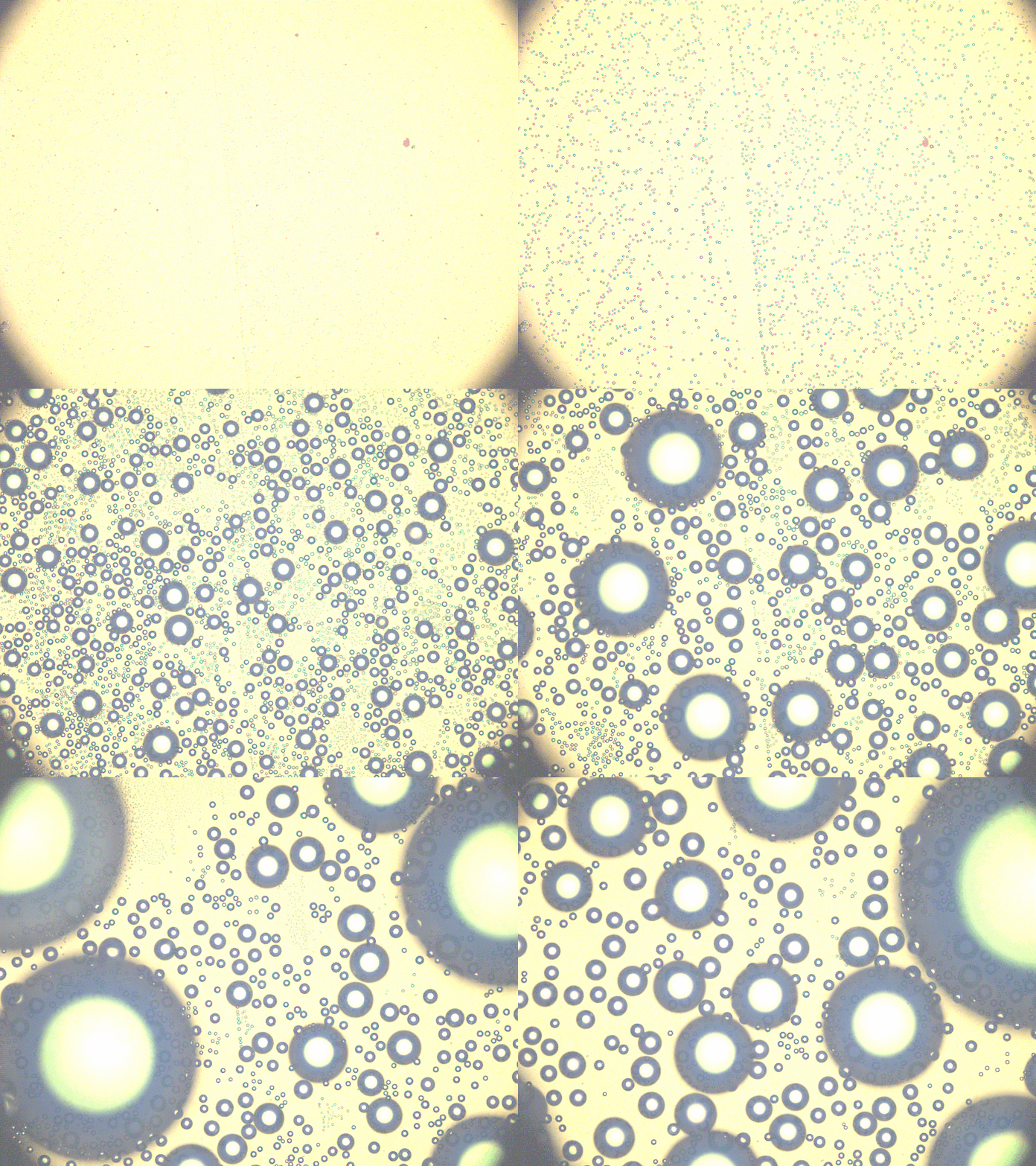
In any heat transfer device, the condenser surface inevitably becomes covered with tiny water droplets. Removing this water is an engineering design challenge as it blocks efficient heat transfer. 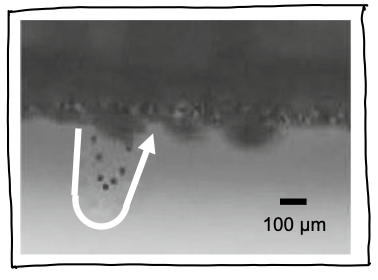 Jumped droplets may return on an upside down surface, being caught in the incoming vapor stream.On ordinary metal surfaces, these droplets merge and eventually grow large enough to roll off under gravity, provided the surface is at an angle other than horizontal. Superhydrophobic surfaces offer a clever alternative: their extremely low adhesion allows the excess surface energy released during merging to be converted into an out-of-plane velocity. This is the basis of jumping-droplet condensation, one of the most efficient modes of condensationWang et al., Nano Letters, 2012 discovered to date.
Yet, real surfaces are never perfect. Droplets pinned by surface defects can no longer jump after merging, resulting in surface flooding as condensation continues. A majority of the droplets will return at the end of jumping. Even surfaces in upside-down orientation can have returning droplets, driven by vapor flow entrainment near the surface. Our experiments (with two talented undergraduate researchers) reveal that, over more extended condensation periods (3 hours or more), tilted surfaces consistently outperform horizontal ones, where gravity lends a hand in clearing droplets and sustaining efficient heat transfer.
Plant pathogens piggybacking on jumped droplets
Published in Proceedings of the National Academy of Sciences, August 2021
Read the paper here
What could a deadly wheat disease possibly have in common with jumping-droplet condensation? Quite a lot, as it turns out. Working with plant pathologists at Virginia Tech, we studied wheat leaves infected with Puccinia triticina, the fungus responsible for devastating leaf rust. Surprisingly, as these leaves are naturally superhydrophobic, dew droplets can jump off them (see the video below), carrying fungal spores along for the rideBoreyko et al., J. Royal Soc. Interface, 2019.
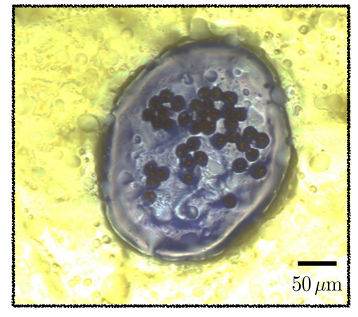 A spore-laden droplet on a water-sensitive paper. To mimic a field transmission event in the lab, we attached an infected leaf to a Peltier stage to induce condensation. Then the leaf was surrounded with water-sensitive papers placed at different angles, emulating real crop conditions. Each time a jumped droplet landed, it left a blue mark on one of the papers in the array, allowing us to map how far and in what directions droplets could travel, along with a lower bound for the amount of droplet-laden spores being carried by wind. The results revealed that even the gentlest of breezes can enable the passive dispersal of pathogens through natural dew cycles. In other words, the same physics that makes droplets jump in engineered condensers may also help spread plant epidemics.
Another jumping event, this time with frost
Published in ACS Nano, February 2021
Read the paper here
This project began as what seemed like a failed frost experiment, or at least that’s what we thought. We were trying to find ways to delay frost formation on cold surfaces. In one experiment, when a small vial of liquid water was brought close to a frosted sample, the micrometer-scale dendrites began to twitch, fracture, and then leap toward the droplet as if pulled by an invisible force. 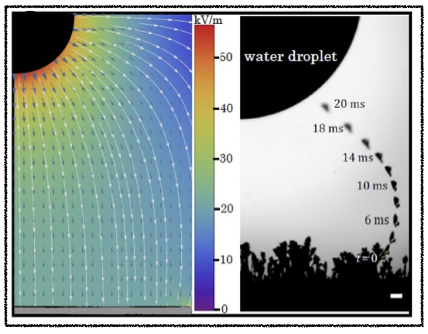 A dendrite broken from the surface follows the non-uniform electric field formed by the water droplet and the frost sheet beneath.What started as a curious accident quickly turned into an entirely new line of research.
We traced the answer back to the atmospheric research works, majorly from 1940–60 and to classical electro-diffusion theories in iceLatham and Mason, Proc. Royal Soc. London, 1961. Based on this, a growing frost sheet undergoes a spontaneous charge separation process due to the differential mobility of its defects, resulting in the top part of the frost having a slightly negative charge. When we bring a polarizable liquid (e.g., water, ethyl alcohol, etc.) near this frost, an electric field is developed.
The simple table-top experiments could measure the amount of charge on a broken dendrite, corroborated by our collaborators via a much more involved electro-diffusion numerical model.
Epilogue
I will be joining the Mechanical Engineering Department at IIT Kharagpur in December 2026. I will be working on developing table-top physical analogs of soil, cells, organs, and other natural systems and processes. The experiments will be fun, producing striking images and vidoes, and our job would be to make sense of all to learn a bit more about the most complex systems around us. Watch out for more info here.
Connect with me through my email, mranit33 at vt dot edu